

It is best to begin with the meaning of linear marketing before venturing into the modern multi-touch digital world, which is fast-paced.
The meaning of linear marketing is based on its simplicity, as it is a step-by-step process, which takes the customer through the predictable path, i.e., taking him/her to awareness, to consideration, and finally, to purchase. The model has defined trust building and conversion in brands over decades.
Think of the customer experience as a well-marked, smooth highway, not too complex to follow, with all the signboards (ad, email, or TV spot) showing the next one in a straight and clear manner. That is the straight line marketing funnel, and it was functional in most of marketing history.
However, as we are going to see later, that clean road has now become a maze of loops, byways, and shortcuts.
The Linear Marketing Funnel: The Foundation of Traditional Advertising
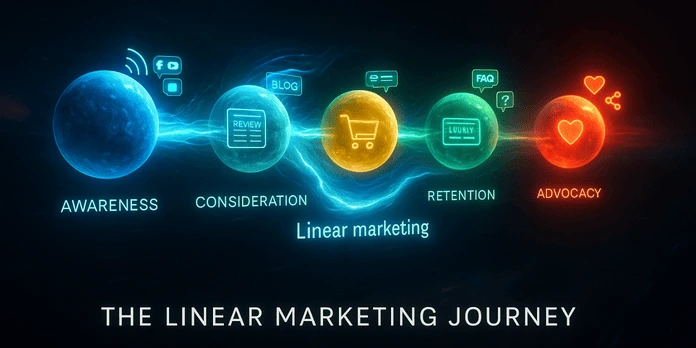
Predictability was used to construct linear marketing funnel models. They were dependent on mass media such as TV, print, and billboards to relay messages to the outside.
And this was the appearance of the traditional funnel:
- Awareness: Creating awareness through either TV or print advertisements.
- Interest: Learning to be interested in offers and storytelling.
- Desire: The deepening of emotional bonding by branding.
- Action: Making purchases through direct calls.
Stages were smooth, quantifiable, and structured in a sequence that was a dream of a marketer.
However, in the present day, the previously straight line has begun to bend. There is no longer a smooth flow between the stages of the consumer. BCG (2025) states that such activities as scrolling, streaming, searching, and shopping are no longer performed in a sequence, but rather in parallel. This complexity can no longer be held in this funnel.
Gist:
A linear marketing funnel is used to enable marketers to regulate the path. The said control is dissipating today because consumers are searching, bypassing, and looping through several touchpoints simultaneously.
What Is the Linear Marketing Model?
Then what is the linear model of marketing? Personally, it is a planned procedure in which a marketer has control over every phase of influence. You take the audience through the process step-by-step, and deviation is kept to a minimum.
In the past, this model had been most effective in:
- Restricted media environment (TV, Radio, print).
- Homogeneous audiences of similar habits.
- Any brand-building initiatives that are long-term.
The linear marketing model deals with repetitive persuasion. One message builds trust, one after another, message after message.
Imagine it is a symphony – each instrument (awareness, interest, desire, action) is in harmony with the others to culminate in a single crescendo; the sale.
However, the current-day consumer does not listen to a single song. It is remixed, skipped, and even ad-libbed by them.
Gist:
Linear marketing is based on control, order, and repeatability; however, predictability is becoming less popular in an algorithmic and immediate gratification world.
Linear Marketing Agencies and Groups
Linear marketing agencies and linear marketing groups are agencies that still use this strategy. They excel at:
- Progressive brand storytelling.
- Sequential campaign design
- Proficiency in TV and print advertising.
- Science results that are measurable and predictable.
Such agencies fulfill the needs of consistency and control by clients in financial institutions, healthcare, and real estate. They make the stages of the campaigns measurable and strategic.
At Creative Zinc, we have realized the strength of a linear approach to methodology, but with a contemporary approach with adaptations whereby predictability and adaptive approaches are combined as a response to real-time consumer behavior.
Gist:
Organized and stable campaigns are provided by the linear marketing agencies. Flexibility, however, has to be incorporated in the modern agencies to be effective.
Linear Marketing Sites
A linear marketing site is reflected digitally:
- Homepage (Awareness): Well-engaging messages.
- About Page (Interest): This is credibility and trust.
- Page of products (Desire): Features the advantages and social evidence.
- Checkout Page (Action): Non-complicated and convincing.
These sites take users through the site one after another, but then there is a tendency for visitors to move past the steps and simply move to a purchase. This points to the shortage of strictly linear digital experiences.
Gist:
Linear marketing sites provide order, yet modern consumers are jumping further steps, and there is a need to be flexible digital strategies.
Linear Video Advertising
Linear video advertising can be described as scheduled and sequential advertising: classical television advertisements, pre-roll ads, and time-based OTT advertisements. They depend on sequence and timing to create awareness and action.
According to the reports of BCG, consumers are 2.5 times more likely to buy the brands that were shown through digital video than through traditional TV, which demonstrates the long-term effectiveness of storytelling in the right way.
Examples of linear advertising are:
- Coca-Cola opens happiness campaigns.
- The product launch cycles at Apple.
- Nike’s “Just Do It” initiatives
Such campaigns are evidence of the power of structured storytelling and a hint of why the linear model fails in a nonlinear online space.
Gist:
Linear video advertisement is still in operation, but needs to change to suit the current consumption behavior, where audiences decide what, when, and how they watch.
Why Linear Marketing Is Failing And Non-Linear Rising in the Digital Age
Although it was successful in the past, linear marketing is experiencing significant challenges in the current fast-paced multi-platform ecosystem that is fast-paced. Here’s why:
1) Consumers Don’t Follow Straight Lines Anymore
The days of the recognizable consumer paths are gone. Contemporary purchasers are free to move in and out of phases, and this is determined by various sources.
Stat: TikTok reports that 1 out of 2 users find new brands every month, which means that they see brands all the time outside the traditional funnels.
The consumer can view the product advertisement on Instagram, read the reviews on Reddit, and buy on Amazon without following the traditional steps that marketers use.
2) The Linear Funnel Ignores Multi-Platform Influence
Split attention spans refer to the viewers scrolling, streaming, searching, and shopping simultaneously.
Scenario: someone watches a drink commercial on YouTube, looks up information on Reddit, and uses a digital coupon to purchase it in-store. The linear model does not consider these intersecting touchpoints; thus, it is not as good at tracing influence.
3) Data and AI Have Redefined the Buyer Journey
Personalization can be performed on a large scale with automation and Generative AI (GenAI), which responds to real-time behavior. This is unlike the case of static linear funnels, which are not able to dynamically adapt to emerging preferences or intent.
Linear models did not support the ability of marketers to optimize campaigns in real time as they respond to every interaction.
4) Linear Video Advertising Has Lost Its Edge
Video advertisement used traditionally is based on the use of scheduled spots, i.e., TV ads or pre-rolls. Non-linear advertising, such as YouTube, OTT, and TikTok, is more popular with the audience since they provide on-demand and shareable content.
Linear campaigns can create anticipation, whereas non-linear strategies can be engaged instantly, have social proof, and be discovered by the user, which is better than TV-first strategies.
5) Linear Campaigns Miss the Loop Effect
Modern brands have learned to live on habit-forming loops, which promote repetition.
- Duolingo: Learning habits are created by gamification and daily reminders.
- Starbucks: Customized difficulties and rewards of apps promote return visits.
- Shein: Social discovery and integration of influencers form endless loops of browsing.
Linear campaigns, on the other hand, emphasize a single conversion, where they do not have growth opportunities to foster a long-term relationship.
6) The Linear Model Can’t Keep Up With Real-Time Feedback
The consumers of today produce feedback at all times: feedback in the form of reviews, social posts, and community insights. Linear campaigns are not that dynamic and cannot adapt to these loops, which makes them appear old-fashioned and less trustworthy.
7) The Linear Marketing Group Mentality Limits Creativity
Conventional agencies that have been mostly linear funnel thinkers (the Linear marketing Group or Linear Marketing Site way of thinking) tend to limit creative experimentation.
In comparison, Creative Zinc maximizes influence mapping and adaptive funnel, which are equally focused on the accuracy of data and the innovation of stories to capture the audience more dynamically.
Gist:
The inflexibility of linear marketing does not reflect the dynamics of the multi-channel, AI-based, and feedback-intensive consumer experiences. In modern agencies, it is necessary to be adjusted, combining predictability and agility.
The Shift from Linear to Nonlinear Advertising
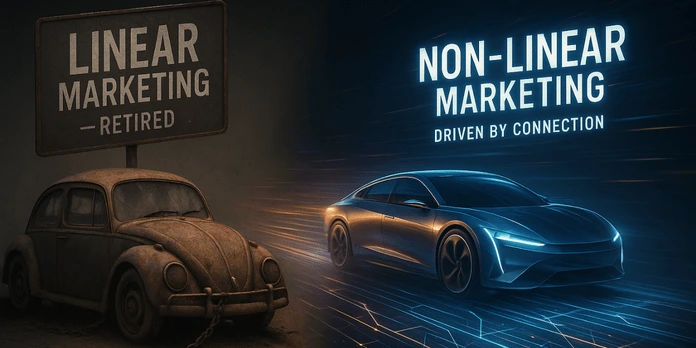
Nonlinear advertising has broken the traditional funnel. Consumers are using an overlapping and unpredictable series of micro-journeys into the brand.
TikTok, Reddit, and Instagram are platforms that allow endless discovery, and these platforms use AI to personalize routes, resulting in a dynamic marketing environment that is driven by influence.
The marketing lesson: linear marketing is not obsolete but requires a combination with nonlinear strategies – influence mapping and loop-based engagement, as well as real-time feedback, are required.
Gist:
Marketing in the future involves combining the linear narrative with the nonlinear experience, which is a flexible, multi-touch experience that consumers can experience anywhere they are.
Practical Tips for Modern Marketers
- Influence in mapping, rather than conversion: Determine where consumers are determined at touchpoints.
- Embrace the power of AI and GenAI: Engage with AI to do personalized work and predictive targeting.
- Design loop: Design the campaigns that would promote repeat purchase, word of mouth, and loyalty.
- Stabilize linear narrative and nonlinear discontinuity: Linear message delivery remains, but it should be disrupted by giving consumers the option of moving past, replaying, and going where they wish.
Gist:
Effective contemporary marketing honors the principles of linear strategy, but it prospers through the application of adaptive, multi-channel engagement with artificial intelligence advancement.
Final Thoughts
Linear marketing set up the basis of the modern-day advertising, organized, predictable, and quantifiable. However, in a modern, technologically focused world, inflexibility is a weakness.
The most winning brands have integrated the accuracy of the linear approaches with the dynamism of the nonlinear systems. Creative Zinc, as well as other agencies, through the comprehension of influence maps, AI-based insights, and engagement loops, assists brands in navigating the complex, multi-touch consumer environment, transforming previous funnels into living, responsive experiences.
Marketing is now a ball of order and chaos, governance and anarchy, linear and nonlinear, and balancing the two is the trick to long-term success.
FAQs:
a) What is linear marketing?
Linear marketing is a process of consumers making purchases in a predictable manner and guided through awareness. Agencies such as Creative Zinc adopt such an approach to develop transparent, sequential campaigns that delight the audience with their decisions.
b) What is the difference between linear and non-linear marketing?
Linear marketing is structured, whereas non-linear one permits a consumer to skip the steps or go through several channels. Creative Zinc takes a balance between these two and employs linear structures to be clear and non-linear strategies to engage in the present day.
c) What are the 4 methods of marketing?
Such marketing strategies are linear marketing, digital marketing, content marketing, and experiential marketing. Linear marketing forms the basis of many of the efforts employed by Creative Zinc, which overlaid adaptive techniques to target audiences on a variety of platforms.
d) What is the linear model of marketing?
The traditional funnel model of marketing is the linear one, i.e., the one that leads the consumer through several stages from their awareness to the purchase point. Creative Zinc uses this model to make the campaigns structured, consistent ,and measurable.