


Quarterly business review can be viewed as a standard meeting- something that businesses organize after three months to have a look at the progress. The thing is, though, that in the majority of companies it is done in the wrong way. Rather than remaining a strategic growth instrument, the quarterly business review (QBR) becomes a dull presentation of figures that no one actually knows or takes any action.
This is precisely the reason why poor ROI, lack of alignment, and slow growth are some of the problems that many businesses grapple with. It is not the idea of a quarterly business review that is the issue, but rather the performance. When properly executed, a QBR can revolutionize the decision-making process of businesses, performance tracking, and scaling.
Here, you will get to understand why most QBRs fail, the difference between a strong quarterly business review and a weak one, and how you can make your QBR a real growth engine.
What Is a Quarterly Business Review (QBR)?
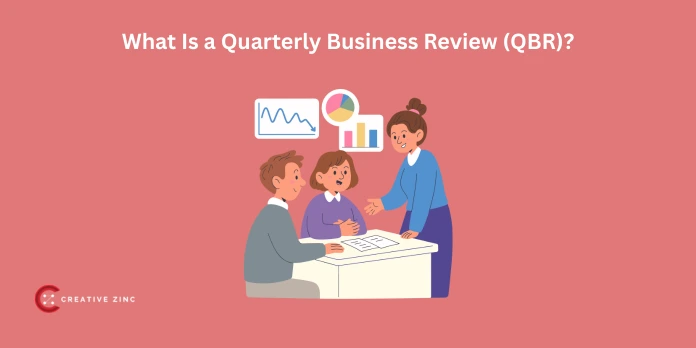
A quarter business review is not a mere performance report. It is a quarterly, planned meeting that aims at reviewing the progress, setting objectives, and developing. A QBR, which is properly executed, will keep businesses and stakeholders on track in the right direction with a sense of purpose.
Unlike most companies, which take it as a reporting session, the real worth of a quarterly business review is that it permits the linking of information to decision-making. It is not the presentation of numbers, it is the comprehension of the meaning of these numbers and what should be done.
Simple Definition (Business-Oriented)
A quarterly business review (QBR) is a business meeting where the business reflects on the previous performance, spot areas of gap, and determine courses of action to be undertaken in the next quarter to achieve quantifiable growth.
The Real Purpose of a QBR (Beyond Reports)
A quarterly business review is much more than just the measurement of metrics. It is designed to:
- Establish business objective and anticipation.
- Demonstrate measurable ROI
- Determine opportunities and threats.
- Establish better decision-making structures.
QBR vs Ordinary Client Meetings
An update-based meeting is about regular, and a strategy-based meeting is about a quarterly business review. Tactical meetings are regular, whereas a QBR is strategic. It leaves behind the topic of what happened and moves on to what we do now.
Why Most Quarterly Business Reviews Fail
Although it has its significance, the majority of quarterly business reviews do not produce actual value. Companies spend time and effort making presentations, but those are poor and ineffective. This is so because the attention is, in most cases, misplaced.
Failure to have a successful QBR does not indicate that the business is not generating data; it is simply not using it in the right way. The distinction between the useless and powerful QBR is in the way in which the insights are drawn out and translated.
1. They Focus on Data, Not Insights
Quite a number of QBRs provide charts, graphs, and metrics without clarifying their purpose. Data is interpretable and not descriptive.
2. No Clear ROI Is Presented
A quarterly business review has to respond to one question: What value have we created? The QBR will not accomplish its mission without demonstrating ROI.
3. They Are Too Generic
Having the same template for all customers or companies eliminates customization. A QBR is expected to portray certain objectives, problems, and performance indicators.
4. No Future Strategy or Roadmap
The majority of the QBRs concentrate on the previous performance. The meeting cannot be complete without a strategy on what to do next.
5. Stakeholders Are Not Engaged
In a case where QBRs are one-sided presentations, the stakeholders lose interest. An effective quarterly business review involves being participatory.
5 Proven Fixes That Make QBRs Actually Work
In order to transform a weak quarterly business review into a strong one, businesses need to change their mindset, as it is not a reporting but a strategy. It is not meant to bring data up to the surface but rather build guidance and clarity.
An excellent QBR is action-oriented and results-driven in terms of outcomes. When properly employed, it turns out to be one of the most useful instruments of business development.
1. Turn Data Into Business Insights
Rather than giving the raw numbers, describe the meaning of these numbers. Speaking of which, in case of a decline in conversions as the traffic rose, draw attention to the problem and propose solutions.
2. Always Tie Everything to ROI
All the metrics related to a quarterly business review must relate to business performance, like revenue, customer acquisition, or retention.
3. Customize Every QBR
A generic QBR reduces impact. Customize every quarterly review of business, depending upon specific objectives, industry trends, and business challenges.
4. Include a Clear Growth Roadmap
Past performance should not be the culmination of a QBR. It should have a quarterly plan that lays out strategies and objectives.
5. Make It a Two-Way Strategic Discussion
Establish feedback and discussion. An effective quarterly business review (QBR) is not a one-sided process.
Key Metrics to Include in a Quarterly Business Review
An effective quarterly business review is based on appropriate measures. But as above, having too many metrics may overwhelm stakeholders. It is important to pay attention to the metrics that have a direct influence on business growth.
Knowing these figures allows companies to make appropriate decisions and define what should be improved.
Marketing Metrics
- Website traffic and sources
- Conversion rates
- Cost per acquisition (CPA)
Sales Metrics
- Revenue growth
- Lead quality
- Sales cycle length
Customer Metrics
- Retention rate
- Customer lifetime value
- Engagement levels
Every measure in a quarterly business review must have a clear explanation of how it affected the business.
How to Structure a High-Impact Quarterly Business Review
The effectiveness of a quarterly business review is determined by its structure. QBR should be well organized and provide clarity, engagement, and actionable results.
Even the best data may have no value unless it has a proper framework. The powerful structure will help to stay focused and cover all important areas.
Step-by-Step Structure
- Performance overview
- Key wins and achievements
- Challenges and gaps
- ROI analysis
- Next quarter’s strategy
- Action plan
The different components of the quarterly business review must be logically structured as they direct the stakeholders on the basis of past performance to future actions.
Real-World Example of an Effective QBR
In order to see the effect of such a strong quarterly business review, one can take the example of a business that has low conversions even after the high traffic.
First, their QBR concentrated on increasing traffic only. They, however, upon restructuring their quarterly business review (QBR), realized that low conversions were due to user experience problems.
By filling this gap with a strategic approach, the business increased the conversions in the following quarter by a significant margin. This case illustrates the ability of an effective QBR to change results.
How Top Agencies Use QBRs to Drive Client Growth
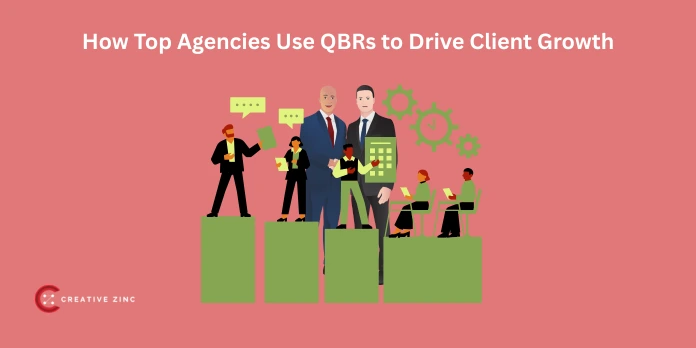
Successful agencies view the quarterly business review as a strategic process as opposed to a reporting one. They apply QBRs to foster trust, goal alignment, and achieve quantifiable outcomes.
They relate all the insights to business results instead of relying solely on performance measures. This will make the QBR an engine of growth.
Key Practices
- Focus on strategic insights
- Position marketing with business objectives.
- Optimize campaigns regularly.
An effective quarterly business review (QBR) enables the agencies to present themselves as growth partners and not service providers.
Why QBRs Are Essential for Long-Term Business Success
Quarterly business review is not a one- time short tool. It is important in long-term business success since it will lead to continuity, alignment, and continual improvement.
Companies that perform successful QBRs on a regular basis will be more prepared to change and embrace new opportunities.
Key Benefits
- Better decision-making
- Improved client retention
- Scalable growth strategies
The appropriate quarterly business review forms a robust platform of sustainable development.
Common QBR Mistakes to Avoid
Despite the appropriate structure, some errors may decrease the efficiency of the quarterly business review. The prevention of these errors is the key to maximum impact.
This is because the awareness of such pitfalls will enable businesses to fine-tune their strategy and achieve better results.
Mistakes
- Burdened with redundant information
- Lack of preparation
- No actionable insights
- Ignoring business goals
Every error undermines the goal of the quarterly business review (QBR) and its efficiency.
How Creative Zinc Delivers Results-Driven QBR Strategies
An effective quarterly business review takes skills, a plan, and implementation. It is in this place that professional agencies are significant.
Creative Zinc focuses on each quarterly business review based on data analysis, individualized strategies, and attainable outcomes. They do not use generic templates, as each QBR is adjusted according to the objectives of the business.
This is because their strategy will make all QBRs provide clarity, direction, and actionable results. They also assure continuity in the growth of businesses by ensuring that the business concentrates on ROI and optimization, being a consistent factor.
Final Thoughts: Turning QBRs Into Growth Engines
A quarterly business review is not a mere meeting, but it is a business growth weapon. It can lead to clarity and bring about alignment and better decision-making when done well.
The variation between a failed QBR and a successful one is in the way it is arranged and provided. Using insights, strategy, and action, companies can turn their quarterly business review (QBR) into a business engine.
And to get some consistent results, better ROI, and grow your business with an effective implementation, then it is high time to reconsider the way you carry out your quarterly business review.
FAQs:
What would you consider a quarterly review?
A review of its performance in the past quarter, major wins and improvement must be covered. It has to contain insights that are actionable, ROI analysis and measures that count. Last but not least, it must define a clear course of action and further course of action in the next quarter.
Which is the distinction between EBR and QBR?
An EBR (or Executive Business Review) is concerned with top-level strategic dialogues with top executives. A QBR (Quarterly Business Review) will be more elaborate and will discuss operational performance and progress. Basically, EBR is strategic management whereas QBR is a mixture of strategy and implementation.
What does QBR differ with OKR?
QBR is a periodical performance review, a review of alignment and strategy, andOKRs (Objectives and Key Results) are goal systems. QBR measures the progress and informs the planning process, whereas OKRs establish the quantifiable goals. In combination, OKRs can inform what will be discussed during a QBR.
How is the quarterly review done?
The process of conducting a quarterly review starts with getting data and performance metrics. Then it discusses findings, finds some gaps and draws conclusions. Lastly, it establishes objectives, creates a road map and allocates steps to be undertaken during the next quarter.